Policing the Media to do better: An Assessment of how the Media Portrays Police Brutality
There is not any issue someone cannot think of that needs to be fixed in the world. One issue that certainly needs to be fixed immediately is police brutality. Police brutality is essentially the unnecessary killing of innocent individuals. It appears as time goes on, there are more and more reports about how the police have misused their power in order to kill innocent individuals.
The fact that there is a steady increase of the amount of police brutality reports indicates the media is telling the audience that this issue is one of the most prevalent issues in the world. The media telling the audience that the issue of police brutality is one of the most prevalent issues in the world is an example of the agenda setting theory. The agenda setting theory lets the audience know what issue is most important and it is to the detriment of other issues not receiving as much attention.
There are two levels when it comes to the agenda setting theory. The first level is the amount of coverage a particular issue gets and the second level is the focus of an attribute of a particular issue. With the steady increased media coverage of police brutality, the media tends to place more of a focus on the victim of police brutality and what the victim was doing to provoke the police to kill them rather than analyzing the situation from every angle possible. The media placing a focus more on the victim rather than analyzing the situation from all angles is the concept of framing. Framing is the idea of how an issue is presented in the media and how the audience processes that issue based on how it is presented.
There are two types of framing: episodic framing and thematic framing. Episodic framing is the idea of reporting news that shows a specific instance of an issue without any context whereas thematic framing is the idea of adding context to news reports.
In the case with police brutality, the media places a heavy focus on the victim and what they were doing in the situation, which is generally something harmless. The audience will see the media reports that the victim was not doing anything that warranted the police to kill the victim and will process police brutality as something that is extremely unjust. Now while police brutality is certainly unjust, the audience only gets that frame of the situation from the media and the audience base their opinions on police from that. The audience does not get other aspects of the report such as why the police officer(s) did it. Having the situation covered from all angles can have an impact on how the audience perceives the issue of police brutality. The audience will still think it is wrong either way but at least the audience will have knowledge of the situation from all angles to have a more informed opinion on the issue.
It is important to examine the steady increase of police brutality media coverage as well as how the audience’s perception of the issue is based off of the media coverage because a step in making a change to solve this issue is to be aware of all of the facts of the matter. The media has done its job in making sure this issue is well-known but has not done its job in terms of providing all aspects of the issue. Without the audience being full aware of all aspects of the issue, there can only be so much change and the change will not be enough to put this issue to an end without all of the facts. A wide array of sources show that the issue of police brutality is a top news priority but the news outlets are not providing all of the details for each instance of police brutality. This leads to a large number of viewers that are angry and potentially hostile but also not fully informed due to the frames the media creates with this issue and the fact the viewers are not fully informed needs to be changed immediately.
According to Krey’s 2015 article:
“The media has a responsibility to not only report facts, but to investigate and analyze events. Reporting on surface issues, such as police brutality, rather than the root cause of the problem will only perpetuate the cycle of police brutality protests in cities marked with social and economic unrest” (Krey).
This was a key statement Krey made when it comes to the media. Generally, the media will report on police brutalities happening around the nation but never get to the underlying causes of police brutality. This connects to the idea of framing, more specifically episodic framing. The public is constantly seeing these episodes of police brutality as if it were a TV show, except it is completely real. As a result of the public not seeing the media get to the underlying causes of police brutality, the public will see continuous conflict with no resolutions and therefore more protests will ensue.
According to Krey’s article, without knowing all of the facts of the issue because of the frame the media has presented to the audience, the police brutality protests (some violent) will continue to take place. The audience knowing the cause of the problem will help stop some of the protests which will be good because some protests against police brutality have been violent. Again, it is good the public is aware of the issue of police brutality but the public should also be aware of why it is an issue and also be aware of the causes of the issue. The public is only seeing numerous reports of police brutalities happening all the time and that can only lead to a misinformed opinion on how to go about the matter.
Scutti’s 2014 article talks about a specific instance of police brutality: The Ferguson case. She talks about how the officer who killed Mike Brown in Ferguson, Missouri received no indictment for his actions. The result of the officer, Darren Wilson, receiving no indictment has led to a violent protest in the city of Ferguson. There was a numerous amount of media outlets that reported the ruling of Darren Wilson. This article relates to Krey’s article by showing that an instance of police brutality being portrayed in the media can lead to protests and in this case, violent protests. This is an example of the agenda setting effect, where the numerous amount of reports leads to a response from the public.
Scutti suggests that the media are like electronic parents, having powerful influences on how we see the world. A wide array of media outlets reported Officer Wilson received no indictment for killing Mike Brown and as a result, the public turned hostile. Scutti suggests the more media outlets reporting on a subject, the greater the public response will be. In the Ferguson case, the public response was certainly great because the media was able to consistently set the agenda on the issue.

Response in Ferguson, MO
- This image is at the sight of a protest in Ferguson, Missouri where the protest turned chaotic and police had to use more forces than normal to ironically (in cases of police brutality) keep peace in the streets.
According to Edwards-Levy, there is a division among ethnicities and political parties with how much the media covers certain instances of police brutality. In her article, it is shown that the majority of Republicans and white Americans think the issue of police brutality receives too much media coverage. It is also shown that the majority of Republicans and white Americans think the media is biased against police officers and is biased in favor of racial minorities.
It is shown in her article that the major of Democrats and minorities mostly think police brutality is getting the right amount of media coverage and that the media is not biased against police officers and not biased in favor of racial minorities. The division between ethnicities and political parties when it comes to how they think the media is covering police brutality is important because it shows that one’s background can be a key factor when analyzing the issue of police brutality. However, regardless of background, the concept of agenda setting and framing go hand in hand with this example because one side, Republicans and white Americans think there is too much media coverage of police brutality cases.
Therefore, this group thinks there are other issues that are far more important than this one and as a result, when this group constantly sees police brutality coverage in the media, the frame the media presents has little to no impact on this group. On the other side, Democrats and minorities think the amount of media coverage police brutality gets is just right. Therefore, this group thinks this issue is one top priority and as a result, when this group constantly sees police brutality coverage in the media, the frame the media presents has a huge impact on this group.
According to what Pollack and Allern stated in their 2014, there is an unbalance with how the media portrays police brutality instances. They suggest the media focuses more on the other individual rather than having a balanced coverage basically saying in a case of police brutality, that the media will focus more on what the victim of police brutality was doing rather than covering all angles of the matter.
“News is a representation of authority, and police sources often represent the authorized versions of reality. Nevertheless, news organizations and journalists simultaneously ‘retain meaning making power’ through their control of the final headlines and news texts (Carlson & Franklin 2011: 6, Ericsson et al. 1989: 339)” (Pollack & Allern 2014).
This quote further accentuates the notion that the media will focus more on the victim on the instance of police brutality. If the media focused more on the side of the police, that would essentially be a violation of authority. Since the media outlets do not want to violate the authorized versions of reality, the media outlets create a frame when they are reporting these cases of police brutality that generally do not look at the case from the police’s standpoint. Most reports are victim focused and as a result the audience does not get the full depiction of the case. Perhaps this would not be the case with untraditional news sources reporting on the issue.

The frame can change
- This image depicts the media has the ability to impact how a story is viewed; therefore it is vital the media is thorough and complete when reporting on an issue.
According to McLaughlin’s report on CNN, police brutality is an issue that has been in existence for several years but mainstream media coverage of police brutality has only been in effect for about a few years. This connects to the idea of agenda setting, more specifically the first level of agenda setting because mainstream media sees this issue as one of the most important over the past few years even though this issue has been going on for quite a lot of years.
His report also goes on to mention that it is good people are now recording interactions between civilians and the police with their phones and sharing it to the internet to spread awareness in a more instantaneous manner. However, he believes this is to no avail in terms of solving the actual issue of police brutality, denoting that the police officer(s) can convince any superiors that their actions were justified. Although this may be the case, the fact that people are recording interactions between civilians and the police is eliminating the frames traditional media, TV and radio, are creating, which is a step in the right direction.

- This picture illustrates the media capturing a potential instance of police brutality as it is happening.
An article by Jim DeBrosse written in 2013 talks about the Kent State University incident that occurred in 1970 where the Ohio National Guards opened fire on protesters and killing four of them. He points out the local media’s failure to warn victims that the Nation Guards were going to open fire. A lack of media coverage essentially resulted in lives being lost from this particular incident. So while the concept of agenda setting has been explored to explain the increase of attention on the issue of police brutality, this case is an example of where the media did not see this issue as important enough to set the agenda on it to the audience. This indicates whether or not the issue is considered a top-level issue, it should be covered in the media.

- This is a picture of the national guards at Kent State University where the shooting took place on May 4, 1970.
Mediating the Public’s Perception of the Police: An Assessment of how the Media Impacts the Public’s Perception of Police and Cases of Police Misconduct
The media has the power to form and change the public’s perspective on issues around the world. The way these issues are presented in the media can have an effect on how the public views these issues. How the issue of police brutality/misconduct is being portrayed in the media is certainly having an effect on the public’s attitude towards the issue. Of course the issue itself is one where it makes sense for the public to have a bad attitude towards it but the media exacerbates the public’s attitude by how they portray the issue. As a result of the media exacerbating the public’s attitude towards this issue by how they are portraying it, the media is also largely responsible for how the public perceives the police as well as the public’s actions following the cases of police brutality/misconduct.
An article by Miller and Davis written in 2008 highlights the public’s attitude towards the police by comparing the public’s perception of police misconduct to what the public would deem to be satisfactory work by the police. This article contains a study in order to illustrate the authors’ theories. This study sought out to test four hypotheses.
The first hypothesis is that the public’s attitudes towards police misconduct are distinct from the public’s attitudes regarding how well the police are doing their job. The second hypothesis is that the causes of attitudes about police misconduct differ from those pertaining to police effectiveness as well as police responsiveness. The third hypothesis is that negative experiences of police among friends, family and associates have an effect on personal attitudes to the police. The fourth hypothesis is attitudes toward the police are influenced by the news coverage of instances of police misconduct. This study used data gathered through a telephone survey in monthly spans over the year 2002. This data came from five New York neighborhoods that had distinct socio-economic traits.
The results of this study showed that all four hypotheses turned out to be correct. The hypothesis that turned out to be the most accurate is that the public’s perception of police misconduct is influenced mostly by the media. This study showed that while other factors such as ethnic background, geographical location, and personal experiences may have a role in influencing the perception of police misconduct, in the long term, what will have the most influence on the public’s perception of police misconduct is how it is portrayed in the media. Therefore, it is important for the media to make sure they are portraying the issue in the most optimal way.
The first hypothesis is that the public’s attitudes towards police misconduct are distinct from the public’s attitudes regarding how well the police are doing their job. The second hypothesis is that the causes of attitudes about police misconduct differ from those pertaining to police effectiveness as well as police responsiveness. The third hypothesis is that negative experiences of police among friends, family and associates have an effect on personal attitudes to the police. The fourth hypothesis is attitudes toward the police are influenced by the news coverage of instances of police misconduct. This study used data gathered through a telephone survey in monthly spans over the year 2002. This data came from five New York neighborhoods that had distinct socio-economic traits.
The results of this study showed that all four hypotheses turned out to be correct. The hypothesis that turned out to be the most accurate is that the public’s perception of police misconduct is influenced mostly by the media. This study showed that while other factors such as ethnic background, geographical location, and personal experiences may have a role in influencing the perception of police misconduct, in the long term, what will have the most influence on the public’s perception of police misconduct is how it is portrayed in the media. Therefore, it is important for the media to make sure they are portraying the issue in the most optimal way.

Twitter response
- This is a picture depicting an instance of police misconduct, causing people who are seeing this via twitter to become incensed.
- This is a picture depicting an instance of police misconduct, causing people who are seeing this via twitter to become incensed.
An article by Donovan and Klahm written in 2015 highlight what role the entertainment media has with influencing the public’s opinion on crime and justice. This study sought out to test three hypotheses.
The first hypothesis is the authors expect viewers of crime dramas to believe the police are more successful in getting criminals off the street than non-viewers. The second hypothesis is the authors expect viewers to be more likely to believe that misconduct by the police rarely leads to wrongful convictions relative to non-viewers. The third hypothesis is the authors expect regular viewers of crime dramas to perceive the police as more engaging in force more often than non-viewers. Tying in with the third hypothesis, the authors expect viewers of crime dramas to believe the use of force by the police is properly applied and that the greater use of force by the police to be at either sufficient or not enough based on the profile of the fictional suspects. This study was conducted by using data from an online omnibus survey, which is a compilation of multiple surveys formed into one survey.
The study showed that all of the hypotheses proved to be true except for the third hypothesis, that the viewers of crime dramas perceive the police as more engaging in force than non-viewers. Although this was the case, the other parts tied in with the third hypothesis turned out to be proven true. This shows that the regular media has certainly had an impact on the public’s attitude towards police misconduct if viewers and non-viewers of crime dramas view the police equally in terms of how the police engages in force. This is an indication that the non-entertainment media is portraying the issue in a non-ideal way.
The first hypothesis is the authors expect viewers of crime dramas to believe the police are more successful in getting criminals off the street than non-viewers. The second hypothesis is the authors expect viewers to be more likely to believe that misconduct by the police rarely leads to wrongful convictions relative to non-viewers. The third hypothesis is the authors expect regular viewers of crime dramas to perceive the police as more engaging in force more often than non-viewers. Tying in with the third hypothesis, the authors expect viewers of crime dramas to believe the use of force by the police is properly applied and that the greater use of force by the police to be at either sufficient or not enough based on the profile of the fictional suspects. This study was conducted by using data from an online omnibus survey, which is a compilation of multiple surveys formed into one survey.
The study showed that all of the hypotheses proved to be true except for the third hypothesis, that the viewers of crime dramas perceive the police as more engaging in force than non-viewers. Although this was the case, the other parts tied in with the third hypothesis turned out to be proven true. This shows that the regular media has certainly had an impact on the public’s attitude towards police misconduct if viewers and non-viewers of crime dramas view the police equally in terms of how the police engages in force. This is an indication that the non-entertainment media is portraying the issue in a non-ideal way.
An article by Chermak, McGarrell, and Gruenewald written in 2006 look at how renowned cases affect attitudes toward police, i.e. how the cases that are the most publicized and displayed most in the media affect attitudes toward police. For this study, data was collected via telephone surveys from residents of Indianapolis who were from a wide array of areas within the city. The telephone surveys were based around a renowned case of police misconduct that happened in Downtown Indianapolis. There was a survey done prior to the case as well as a survey done after the case.
The results of this study were that the media did not have a substantial influence on the public’s attitude towards the police prior to the case but the media indeed did have a substantial influence on the public’s attitude towards the police after the case. This study showed that the more the public read about it via newspaper, the more negative attitudes the public conceived about the police.
The results of this study were that the media did not have a substantial influence on the public’s attitude towards the police prior to the case but the media indeed did have a substantial influence on the public’s attitude towards the police after the case. This study showed that the more the public read about it via newspaper, the more negative attitudes the public conceived about the police.

Aftermath of Freddie Gray case
- This is a picture depicting the protests in Baltimore in regards to the Freddie Gray case, a widely renowned case.
- This is a picture depicting the protests in Baltimore in regards to the Freddie Gray case, a widely renowned case.
An article from Weitzer and Tuch take a look at how the public perceives instances of police misconduct but from a racial perspective, meaning this article takes a look at how each race views instances of police misconduct. This study sought out to prove six hypotheses.
The first hypothesis is that Blacks and Hispanics are considerably more likely than Whites to believe that police misconduct happens habitually. The second hypothesis is that firsthand and secondhand experience with police misconduct increases the public’s beliefs that misconduct happens habitually. The third hypothesis is that exposure to news reports of police misconduct increases the perception that misconduct happens habitually. The fourth hypothesis is that residents of neighborhoods where crime is high and personal safety is low are more likely to believe that police misconduct happens habitually. The fifth hypothesis is that residents of areas where community policing is practiced are less likely to perceive police misconduct than residents of other areas. The sixth hypothesis is that media exposure and neighborhood crime interrelate in such a way that people who see media reports on police misconduct and who live in neighborhoods with severe crime problems will be particularly likely to believe that police misconduct happens habitually. The data used from this study came from a nationwide survey conducted from residents in metropolitan areas where the population is at least One hundred thousand.
The results of the study showed that all of these hypotheses turned out to be correct, the main one insinuating that Whites do not find police misconduct to be as much of an issue as Blacks or Hispanics do. This is an indication that the media tends to focus on portraying cases of police misconduct against people of color as opposed to Whites. As a result, people of color will generally have more of a negative attitude about the issue since the media is portraying as if it is mostly impacting their community.
The first hypothesis is that Blacks and Hispanics are considerably more likely than Whites to believe that police misconduct happens habitually. The second hypothesis is that firsthand and secondhand experience with police misconduct increases the public’s beliefs that misconduct happens habitually. The third hypothesis is that exposure to news reports of police misconduct increases the perception that misconduct happens habitually. The fourth hypothesis is that residents of neighborhoods where crime is high and personal safety is low are more likely to believe that police misconduct happens habitually. The fifth hypothesis is that residents of areas where community policing is practiced are less likely to perceive police misconduct than residents of other areas. The sixth hypothesis is that media exposure and neighborhood crime interrelate in such a way that people who see media reports on police misconduct and who live in neighborhoods with severe crime problems will be particularly likely to believe that police misconduct happens habitually. The data used from this study came from a nationwide survey conducted from residents in metropolitan areas where the population is at least One hundred thousand.
The results of the study showed that all of these hypotheses turned out to be correct, the main one insinuating that Whites do not find police misconduct to be as much of an issue as Blacks or Hispanics do. This is an indication that the media tends to focus on portraying cases of police misconduct against people of color as opposed to Whites. As a result, people of color will generally have more of a negative attitude about the issue since the media is portraying as if it is mostly impacting their community.
An article from Rasmussen Reports suggests that the news is largely responsible for the volatile and violent response of police misconduct. They state in particular that the instances of police brutality where Blacks are killed instead of instances of police brutality where Whites are killed is the reason for such backlash. Rasmussen Reports found through a nationwide telephone survey that seventy-one percent of people think that the media would give more coverage of an instance of police brutality where a black suspect is involved than an instance of police brutality where a white suspect is involved.
Based off of this survey, Rasmussen Reports conducted another survey of one thousand people where it showed fifty-one percent of Blacks, sixty-five percent of Whites and seventy percent of other minority Americans believed the media coverage of police brutality incites people to attack the police. If this is the case, that indicates there has to be an issue with how the media is portraying the issue of police brutality.
Based off of this survey, Rasmussen Reports conducted another survey of one thousand people where it showed fifty-one percent of Blacks, sixty-five percent of Whites and seventy percent of other minority Americans believed the media coverage of police brutality incites people to attack the police. If this is the case, that indicates there has to be an issue with how the media is portraying the issue of police brutality.
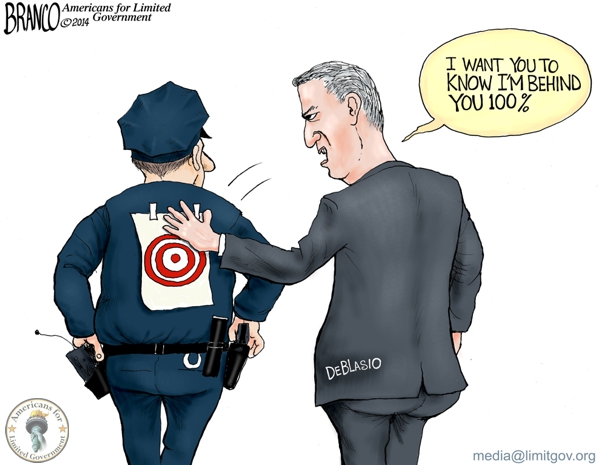
- This picture depicts that the police have a target on them as a result of the public seeing all the cases of police brutality via the media and the person to the right is responsible for that target being placed even though what he says shows otherwise.
An article from Brown challenges the readers to think whether or not the media is altering our perceptions of crime. This article states that eighty-one percent of Americans access some form of media on a daily basis to get access to the news. This article states that with the rapid development of news, the audience gets minute by minute coverage. As a result, the audience learns about instances of crime as they are happening, without having all of the full details of the case. This certainly ties into the case of police brutality, where the audience can potentially be receiving information about the case without having the full details of the case to form a proper opinion about the case.
This article suggests that the backfire effect, which is the case that people favor familiar statements as more likely to be true than unfamiliar statements, is the reason the audience believes that crime is recurrent and increasing. However, according to statistics from the FBI in 2013 showed that nationwide crime has decreased by over four percent. Therefore, this article shows that the more the audience hears about something happening in the news, the more they will believe it is happening in the world. For this reason, the audience will certainly form perceptions about police brutality that may not be fully accurate.
This article suggests that the backfire effect, which is the case that people favor familiar statements as more likely to be true than unfamiliar statements, is the reason the audience believes that crime is recurrent and increasing. However, according to statistics from the FBI in 2013 showed that nationwide crime has decreased by over four percent. Therefore, this article shows that the more the audience hears about something happening in the news, the more they will believe it is happening in the world. For this reason, the audience will certainly form perceptions about police brutality that may not be fully accurate.
- This video shows a reporter being knocked down on live TV while the reporter was
reporting on the police brutality case of Keith Scott. The reporter was knocked
down because the person is outraged with what happened as well as how the media
is portraying the case.
Now while there is discontent with how the portrayal of police misconduct is being displayed in the media, it is important to look at what factors play a role in what makes the public satisfied with the police in order to understand why the portrayal of police misconduct in the media has such resounding negative impacts on the public. An article from Johnson looks at the different factors that have an influence on public satisfaction with the police. A total of twenty-seven studies that surveyed over fifty-five thousand people were used to look at these factors.
The results of this study indicated that the main factors that have an influence on public satisfaction with the police are contact with the police, perceptions of neighborhood crime and disorder, neighborhood police resources, and media exposure. Out of these factors, the results indicated the factor that has the most impact on whether or not the public is satisfied with the police is plausibly negative firsthand or secondhand experience with the police.
Although this study found that negative firsthand or secondhand experience with the police is the most important factor when it comes to public satisfaction with the police, the fact that the media will not provide the full details of an instance of police brutality before reporting on it will incite those individuals who have had those negative experiences with the police to potentially react to the reports with violence since their attitudes about the police are formed (negatively) based on their experience. The reports will give the individuals who have had those negative experiences more of a reason to potentially react to the reports with violence if they are seeing what has happened to them happen to others in the news.
An article by Herwees written in 2015 talks about the ripple effects of police brutality. This article states as the number of instances of police brutality increases at what appears to be an exponential rate that there will be damaging long term psychological effects inflicted on the families as well as the communities of the police brutality victims. One psychological effect highlighted in particular in this article was post-traumatic stress disorder. This occurs from a traumatic event an individual goes through where they are shaken up by the event even after it has been ample time since the event has occurred.
This article suggests that there will be a lot of communities who are impacted by police brutality that could end up suffering from post-traumatic stress disorder, another issue that is birthed from the unfortunate issue of police brutality.
Interview with Susan Scutti
Susan Scutti is a fiction writer, a poet, but most notably a journalist who writes for Newsweek and The Medical Daily. She is an active contributor to articles of Newsweek and The Medical Daily. Scutti makes a good candidate to speak with about this issue because with her being a journalist, she is essentially a part of the media.
With Scutti being a part of the media, I believe she can give a great insight as to the methods the media have in portraying police brutality and why they are portraying police brutality the way that they are. I believe she can give a great insight as to whether or not the media is aware of the effects their reporting on this issue is having on the audience. With the media being so powerful, it is important to analyze the ways in which the media reports on the issue of police brutality. I believe since Scutti is a part of the media, she can certainly help with that analysis.
The first question I asked Scutti is why does the media appear to only focus on the issue of police brutality as it pertains to people of color. I notice that those are the stories that grab the most headlines and generate the most attention, which was essentially her response. She claims the news outlets are focused on reporting things in a way that generate the most attention and cases where a person of color is a victim of police brutality by a white police officer would generate the most attention from the audience.
This response is essentially the same with the next question I asked which is: When reporting on an issue of this magnitude, how often does the media make sure they have as much facts as possible before reporting a story? She added along with generating attention that the element of a “Breaking News” story keeps the viewer interested in the story. So the news outlets want to make sure they are keeping that initially generated attention by reporting as soon as possible without necessarily having all of the facts in order. So she claims the media does their best to make sure they have as much facts as possible but it doesn’t always turn out that they have all of the facts before reporting a story.
Another question I asked Scutti was: Are news outlets (the people who are reporting) cognizant of the impact their reports regarding police brutality are having on the audience? Scutti claims that while they are cognizant of the impact, and have even reported on the public response to their reports, the reports have to remain neutral and report being completely objective. She claims one thing the reporters can do is go to their superiors or production team and see if there are better ways to report that does not incite violence with a subject such as this one. I get the impression that many people at news outlets do not do that.
I also asked Scutti if she believes media outlets think they report on the issue of police brutality the same way as reporting on an issue that would not grab the audience’s attention as much as police brutality. She claims the media outlets make a valiant effort to treat every report on an issue the same but it can be difficult to do based on how serious and prevalent the issue is.
I also asked Scutti what she thinks about the fact that reports on police brutality have only been in the forefront for the past few years when the actual act itself has been in existence for several years. She claims while she is also puzzled why that is the case, she has noticed an increase in reports on police brutality since the Trayvon Martin case (although it wasn’t a police officer who killed Martin). It appears that case has drawn so much attention, especially with the trial, that news outlets felt a need to report on cases similar to this one so they can gain consistent attention.
What have we learned?
With these findings, it is shown that the issue of police brutality is flooding the media because the media sees it as a top-level issue. Also, these findings show that the audience’s view on this issue is primarily based on how the media gives the audience the information, which includes the amount of information given about the issue case by case. These findings highlighted that the media does not give the audience the full depiction of police brutality cases and therefore leads to a non-fully informed perception of how the audience views the issue as a whole.
There are divisions with how certain ethnicities perceive this issue based on how often the media disseminates it and ultimately, these findings show that whether or not the issue remains a top-level issue, it should still be reported regardless. The main issue here is the media has made the effort to make police brutality a top issue but has not made the effort to show every aspect of each case concerning police brutality, resulting in improper depictions of what the audience believes should be done about the issue.
It is also shown that the way police brutality/misconduct is portrayed in the media definitely has a negative impact on how the public views the issue itself as well as how the public views the police. The media must take a look at itself and see what ways they can still portray the issue without creating any kind of backlash from the public.
Can police brutality come to an end if the public is fully informed of every aspect of each case?
References
• Brown, B. (2015, March 11). Is the Media Altering Our Perceptions of Crime? Retrieved October 31, 2016, from http://intpolicydigest.org/2015/03/11/is-the-media-altering-our-perceptions-of-crime/Debrosse, J. (2013). Four Dead in Ohio. Journalism History, 39(1), 40-49.
• Donovan, K. M., & Klahm, C. F. (2015, September 17). The role of entertainment media in perceptions of police use of force. Criminal Justice and Behavior, 42(12), 1261-1281. doi:10.1177/0093854815604180
• Edwards-Levy, A. (2015, May 11). America Is Deeply Divided Over How Media Covers Race, Police Misconduct. Retrieved September 25, 2016, from http://www.huffingtonpost.com/2015/05/11/media-police-poll_n_7259942.html
• Krey, Z. (2015, May 31). Questionable coverage: Police brutality is only part of the problem. Retrieved September 25, 2016, from http://depauliaonline.com/2015/05/31/questionable-coverage-police-brutality-problem/
• McLaughlin, E. C. (n.d.). There aren't more police shootings, just more coverage. Retrieved September 25, 2016, from http://www.cnn.com/2015/04/20/us/police-brutality-video-social-media-attitudes/
• Pollack, E., & Allern, S. (2014). Criticism of the police in the news. Nordicom Review, 35(1), 33-50.
• Risley, A. (2006). Framing violence. International Feminist Journal Of Politics, 8(4), 581-609. doi:10.1080/14616740600945164
• Scutti, S. (2014, November 25). When It Comes To Violent Ferguson Protests, Media May Actually Be To Blame. Retrieved September 25, 2016, from http://www.medicaldaily.com/ferguson-unrest-how-media-consumption-may-have-influenced-violence-after-officer-312176

No comments:
Post a Comment